
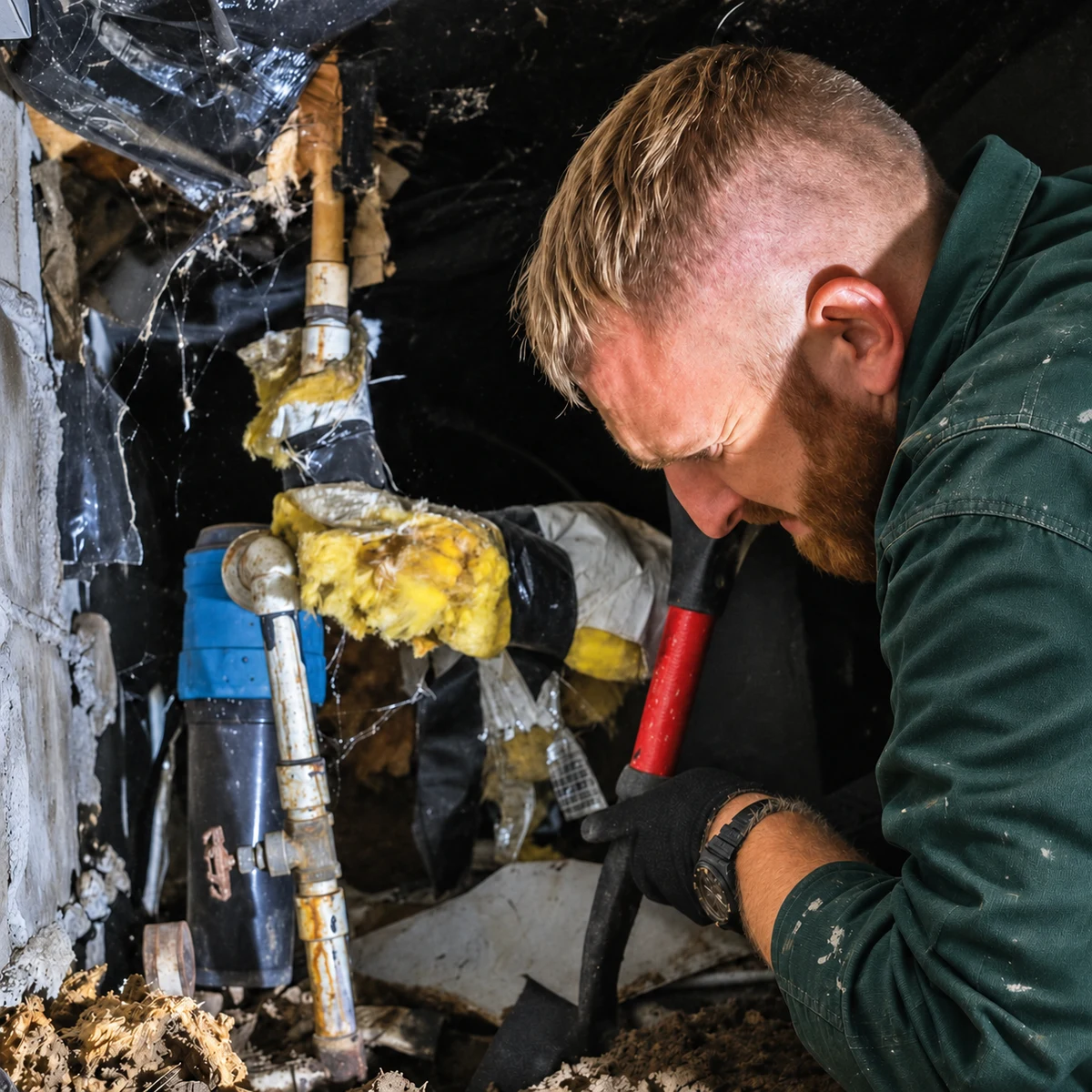
Wipes sold as flushable do not break apart like toilet paper. On a septic system that is not just a clog, it is a tank problem. Here is what we actually pull out of Shore toilets.
Ask a plumber out here what comes out of toilets and you will not get a list of exotic items. You will get the same short list, over, and over, in houses of every kind: wipes, paper towels, feminine products, cotton buds, toys, and a surprising number of keys.
Almost all of it went down because somebody believed it would break apart once it was out of sight. Only one of those things actually does.
The short version. Toilet paper is engineered to fall apart in water within seconds. Nothing else in your bathroom is, including the wipes with the word flushable on the packet.
The wipe problem, without the marketing
Toilet paper is made to lose its structure almost immediately when it gets wet. That is the entire design brief. A wipe is made to do the opposite: to stay in one piece while it is wet, because a wipe that fell apart in your hand would be useless.
When a Canadian university lab put wipes sold as flushable through a standard dispersal test, not one of them broke apart the way toilet paper does. They went down the toilet, which is all the label ever claimed, and then they stayed whole.
What happens next depends on where your waste goes, and out here that is usually not a treatment plant.
On a septic system, a wipe never leaves
A septic tank works by letting solids settle and liquid flow on to the drain field. Anything that does not break down just accumulates. Toilet paper turns to sludge and gets pumped out on schedule. A wipe stays a wipe.
Two things follow from that. The obvious one is that wipes catch on each other, on roots, and on any rough spot in the line, which is how you get a blockage between the house and the tank. The less obvious one is that they take up volume in a tank that is sized for a certain amount of water. A tank filling with material that will not break down is a tank that gives you less settling time, which pushes solids toward the drain field. That is a much more expensive problem than a blocked toilet.
Virginia expects most conventional septic tanks to be pumped on roughly a five year cycle, and the health department can tell you what applies to your system. If your household has been flushing wipes, assume you are due sooner rather than later. We do not pump tanks, so we have no reason to sell you one. We will tell you to call a pumper and get on with the part that is ours.
What we actually pull out
The honest list, from the calls we get:
- Wipes. Baby wipes, cleaning wipes, and the ones sold specifically for adults. The last group is the worst offender because the packaging is the most reassuring.
- Paper towels and tissues. Both are made to hold together when wet. That is why you buy them.
- Feminine products. Designed to absorb and expand, which is exactly the wrong behavior in a four inch line.
- Cotton buds and dental floss. Small, so nobody worries. Floss in particular knits everything else together into a rope.
- Toys, toothbrushes, keys, and phones. No mystery about these, and no amount of plunging will help. They get retrieved, not pushed through.
- Sand. Genuinely. See the tub and shower version of this problem in a clogged shower drain.
Rentals are a different animal
If you own a rental or a place you let out by the week, you already know the pattern: more clogs, more wear, and a bathroom that gets treated like a hotel bathroom because for that week it is one. Guests flush what they flush at home, and half of them flush wipes at home.
Owner occupied houses have the opposite problem. Fewer incidents, but the ones that happen have been building quietly for years, so when something finally goes it goes properly.
For a rental, a sign in the bathroom does more good than anything else we could sell you. Not a laminated lecture, just a line asking guests to put wipes in the bin. It works more often than it should.
When it is not the toilet at all
A toilet that blocks on its own, while every other drain in the house runs fine, has a blockage in its own trap or just past it. That is a straightforward job.
A toilet that gurgles when the washing machine drains, or backs up at the same time as a tub or a shower, is telling you about the main line rather than about itself. Do not keep plunging it, and stop running water elsewhere in the house. That is every drain backing up, and the fix is further out.
What it costs to get it cleared
A single fixture cleared with a cable runs $175 to $450. If the line has blocked more than once in a year, a camera down it at $250 to $500 is worth more than another cable, because it tells you whether you have a wipe habit, a root, or a bad section of pipe. Full ranges are in our drain cleaning cost guide.
If you have a blocked toilet right now
Stop flushing. Take the lid off the tank and push the flapper down if the bowl is rising. Turn the valve behind the toilet clockwise to shut the water off, and leave the chemicals in the cupboard: they rarely clear a real blockage and they make the job more dangerous for whoever opens the line. Then call us, or see clogged toilet repair and drain cleaning.
Are flushable wipes safe for a septic system?
No. They do not break apart the way toilet paper does, so they either catch in the line or sit in the tank taking up space that should be holding water. The label refers to whether the wipe fits down the pipe, not to what happens afterwards.
What is safe to flush?
Toilet paper and what your body produces. That is the whole list. Everything else, including wipes, cotton buds, dental floss, paper towels, and feminine products, goes in a bin.
How much does it cost to unclog a toilet?
A single fixture cleared with a cable runs $175 to $450. If more than one fixture is backing up it is not the toilet, and a main line through the cleanout is $300 to $600.
Can you get an object back out of a toilet?
Usually, yes. Toys, toothbrushes, keys, and phones are common enough that we have the tools for it. Tell us what went down, because a hard object gets pulled out rather than pushed through.
Does the plunger make it worse?
Not if it is the right plunger and you have not already poured chemicals in. Use a flange plunger, be gentle at first to seat it, and stop after a few attempts rather than forcing the blockage further down.
Written by the team at Shoresteady Plumbing, Temperanceville, Virginia. Master plumbing licensed in Virginia and Maryland. Prices shown are typical ranges for the Eastern Shore, not a quote. Your written estimate is the only number that binds either of us.
More from the Shoresteady Plumbing blog
Well and Water Quality
How Much Does Well Pump Replacement Cost on Virginia’s Eastern Shore
Submersible well pump replacement runs $1,600 to $3,800 on the Shore, jet pumps $900 to $2,000. Prices by part, and how to tell whether...
Costs and Pricing
How Much Does Commercial Plumbing Cost on Virginia’s Eastern Shore
Commercial plumbing on the Shore runs $125 to $225 per hour plus materials, with fixed prices on scoped work. Backflow testing, grease ...
Home Maintenance
Is Your Sump Pump Ready for the Next Nor’easter
A ten minute, seven point check you can do yourself before storm season, plus what to do about the backup gap that catches most Shore h...
Reading about it is one thing, fixing it is another
Tell us what is going on and we will get you on the schedule. Written estimate before we start, and a 2-year workmanship guarantee on every job.
Explore related services
- Plumbing answers, straight from our vans
- Clogged shower drain repair
- Every drain backing up? Main line clog or septic
- How Much Does Drain Cleaning Cost on Virginia’s Eastern Shore
- Clogged toilet repair on the Eastern Shore
- Drain cleaning and clogged drains
- How Much Does Well Pump Replacement Cost on Virginia’s Eastern Shore
- How Much Does Commercial Plumbing Cost on Virginia’s Eastern Shore
- Is Your Sump Pump Ready for the Next Nor’easter
Ready for a steady hand?
Book with our team, or call us seven days a week from 8am to 9pm.
Call (757) 824-9862