
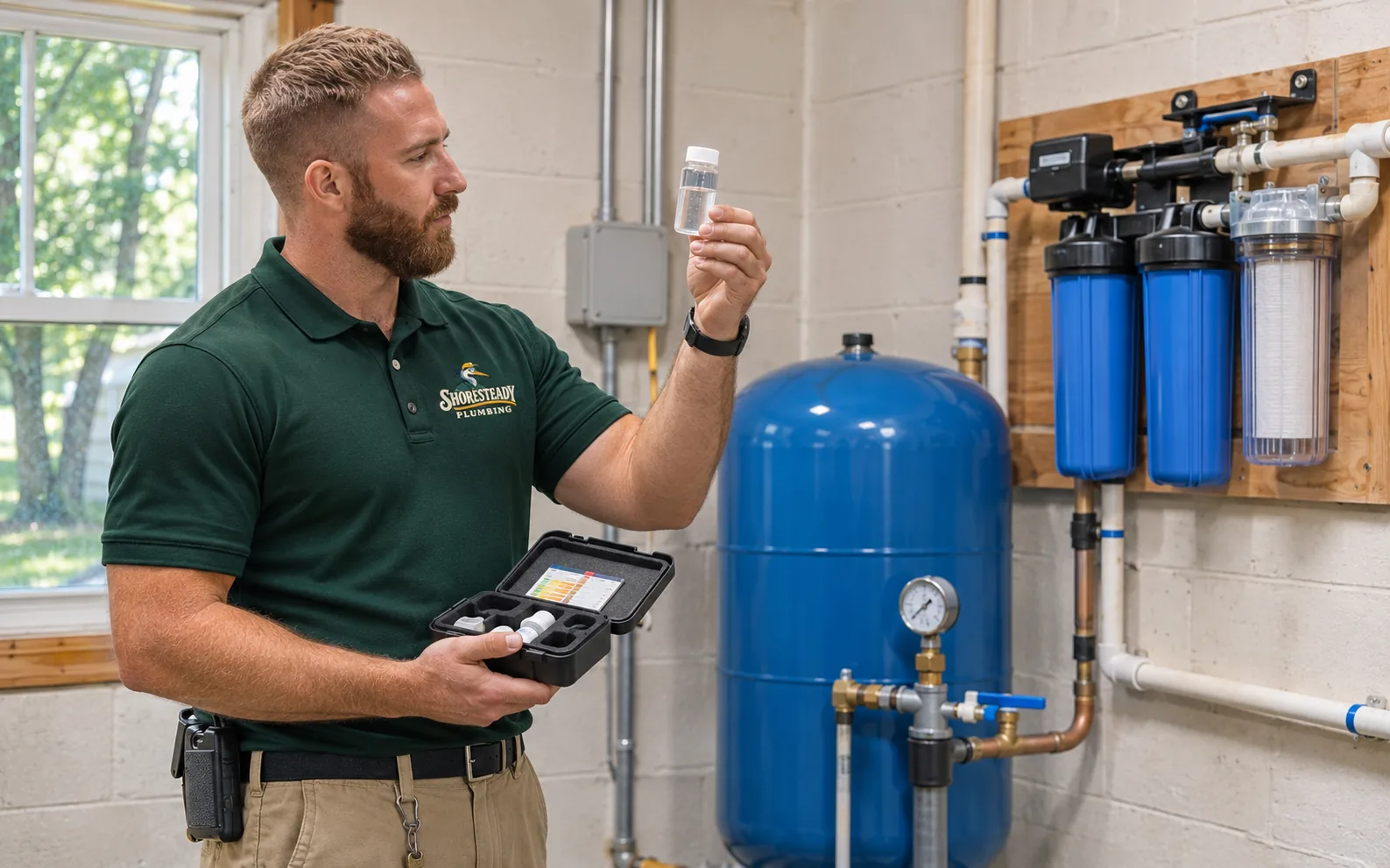
Two of these cost nothing and fix a real share of no-water calls. The other two tell us what to bring, which is how you get water back today instead of Thursday.
The taps go quiet, and the first thought is the worst one: the pump is gone, and that is thousands of dollars. Sometimes it is. Often it is not, and there are four things worth checking before you ring anybody, two of which cost nothing at all.
We would rather you did these than not. A caller who has already checked the breaker and read the pressure gauge gets a more useful answer from us on the phone, and sometimes gets told they do not need a visit.
Safety first. Nothing below involves opening the control box, the wellhead or anything else carrying current. If a check calls for that, it is ours, not yours.
1. The breaker for the pump circuit
It is in the main panel, usually a double pole breaker labeled something like well or pump. Look at whether it has tripped: a tripped breaker often sits between on and off rather than fully off, which is why people miss it.
If it has tripped, reset it once. Firmly off, then on.
If water comes back, you are not finished. Something caused that trip, and the usual causes are a motor starting to fail, a wire that has degraded down the well, or a tank problem making the pump start far more often than it should. It will trip again.
If it trips again straight away, stop. Do not keep resetting it. The breaker is doing its job, and every restart on a struggling motor takes life off it.
2. The pressure gauge on the tank
This is the one that tells us the most, and almost nobody reads it before calling.
Find the pressure tank, usually in a utility space, a crawlspace or a well house. There is a small round gauge on the pipework near it. Note what it says, then run a tap and watch it.
- Zero, and staying at zero. Nothing is being delivered. Pump, switch, or control box.
- It builds, then collapses within seconds of the pump stopping. That is the tank, and the pump is probably fine. It is also urgent, for reasons below.
- It sits at some middling number and will not climb. Often the switch, sometimes a restriction or a failing pump that can no longer reach cut-off pressure.
- It reads normal but you still have no water at the tap. Then the well side is fine and the problem is in the house plumbing, which is a completely different and usually cheaper job.
Write the number down. It is the single most useful thing you can tell us.
3. Listen for the pump
Stand near the tank with all the taps off and wait a few minutes.
Silence, and no water. The pump is not getting the signal or not getting power.
You can hear it running and it never stops. That is a pump running without building pressure. It may be drawing air, the drop pipe may have failed, or the pump itself has. Turn it off at the breaker: a pump running dry damages itself quickly.
It starts and stops every few seconds. That is short cycling, it is the tank rather than the pump, and it is the one on this list that you should act on this week even if you still have water. Every start is wear on a motor that costs $1,600 to $3,800 to replace. There is more on it in short cycling and what it does to a pump.
4. Whether anything happened recently
Two things matter out here more than most places.
Lightning. The Shore gets it, and a nearby strike takes well pump motors and control boxes with some regularity. If the water went off during or just after a storm, say so when you call, because it changes what we bring and it may change who pays. Wear and tear is not covered by a homeowners policy. A lightning strike often is, so keep the invoice and the photographs we take on the job.
A dry spell. In a long dry August a shallow well can drop below the pump. That is not a failed pump, and it usually recovers, though it is worth knowing because running a pump dry damages it.
What each answer is likely to cost
This is the part people want and rarely get up front.
Diagnosis and a well test is $150 to $350, and it exists precisely so that nobody gets quoted for a pump before anyone has established that the pump is the problem. From there: a pressure switch is $250 to $450, a control box or capacitor $300 to $600, a pressure tank $600 to $1,500, and a submersible pump pulled and replaced $1,600 to $3,800 depending on how deep it sits. The full price list is here.
Read that order again, because it is the argument for diagnosing first. The cheapest and the most expensive outcomes are more than ten times apart, and from inside your kitchen they look identical.
What to tell us when you call
- What the pressure gauge reads, with taps off and with a tap running.
- Whether the breaker had tripped.
- Whether you can hear the pump, and whether it stops.
- Roughly how old the system is, if you know.
- Whether there has been a storm or a dry spell.
Five answers, and we will usually know what to load on the truck before we leave. We stock the common pumps, tanks, switches, and controls in our own shop in Temperanceville rather than ordering per job, which out here is the difference between water tonight and water on Thursday.
See well pump repair, or well pumps and pressure tanks for how the whole system fits together.
What is the first thing to check when a well stops giving water?
The breaker for the pump circuit. It is free, it takes thirty seconds, and it is genuinely the answer often enough to be worth doing first. If it has tripped, reset it once. If it trips again, stop and call, because each restart is hard on the motor.
What does the pressure gauge tell me?
Almost everything. Zero with the pump running means the pump is not delivering. Pressure that builds then collapses in seconds means the tank. Pressure stuck below the cut-off means the switch or a restriction.
Is no water an emergency?
We treat it as one. It goes to the front of the schedule, we work seven days a week from 8:00am to 9:00pm, and the price is the same on a Sunday evening as a Tuesday morning.
How much will this cost me?
Diagnosis and a well test is $150 to $350. From there a pressure switch is $250 to $450 and a control box $300 to $600, while a submersible pump pulled and replaced is $1,600 to $3,800. The whole point of the diagnosis is finding out which before anyone quotes you.
Can I keep resetting the breaker until you arrive?
Please do not. A breaker that trips repeatedly is telling you the motor is drawing more current than it should, and every restart shortens what is left of it.
Written by the team at Shoresteady Plumbing, Temperanceville, Virginia. Master plumbing licensed in Virginia and Maryland. Prices shown are typical ranges for the Eastern Shore, not a quote. Your written estimate is the only number that binds either of us.
More from the Shoresteady Plumbing blog
Well and Water Quality
Why Faucets Fail Early on Well Water
If you are replacing faucets every few years, the faucet is probably not the problem. Here is what well water does to them and what las...
Home Maintenance
How Much Does Sump Pump Installation Cost on Virginia’s Eastern Shore
A sump pump swap runs $500 to $1,400 on the Shore, a full new install $1,600 to $3,500, and a battery backup $800 to $1,800. Why the di...
Drains and Sewers
How Much Does Drain Cleaning Cost on Virginia’s Eastern Shore
Single fixture drain cleaning runs $175 to $450 on the Shore, main lines $300 to $600, and hydro jetting $450 to $900. When each method...
Reading about it is one thing, fixing it is another
Tell us what is going on and we will get you on the schedule. Written estimate before we start, and a 2-year workmanship guarantee on every job.
Explore related services
- Plumbing answers, straight from our vans
- Short Cycling: The Cheap Fault That Kills Well Pumps
- How Much Does Well Pump Replacement Cost on Virginia’s Eastern Shore
- Well pump repair on the Eastern Shore
- Well pump and pressure tank installation, repair, and replacement
- Why Faucets Fail Early on Well Water
- How Much Does Sump Pump Installation Cost on Virginia’s Eastern Shore
- How Much Does Drain Cleaning Cost on Virginia’s Eastern Shore
Ready for a steady hand?
Book with our team, or call us seven days a week from 8am to 9pm.
Call (757) 824-9862