
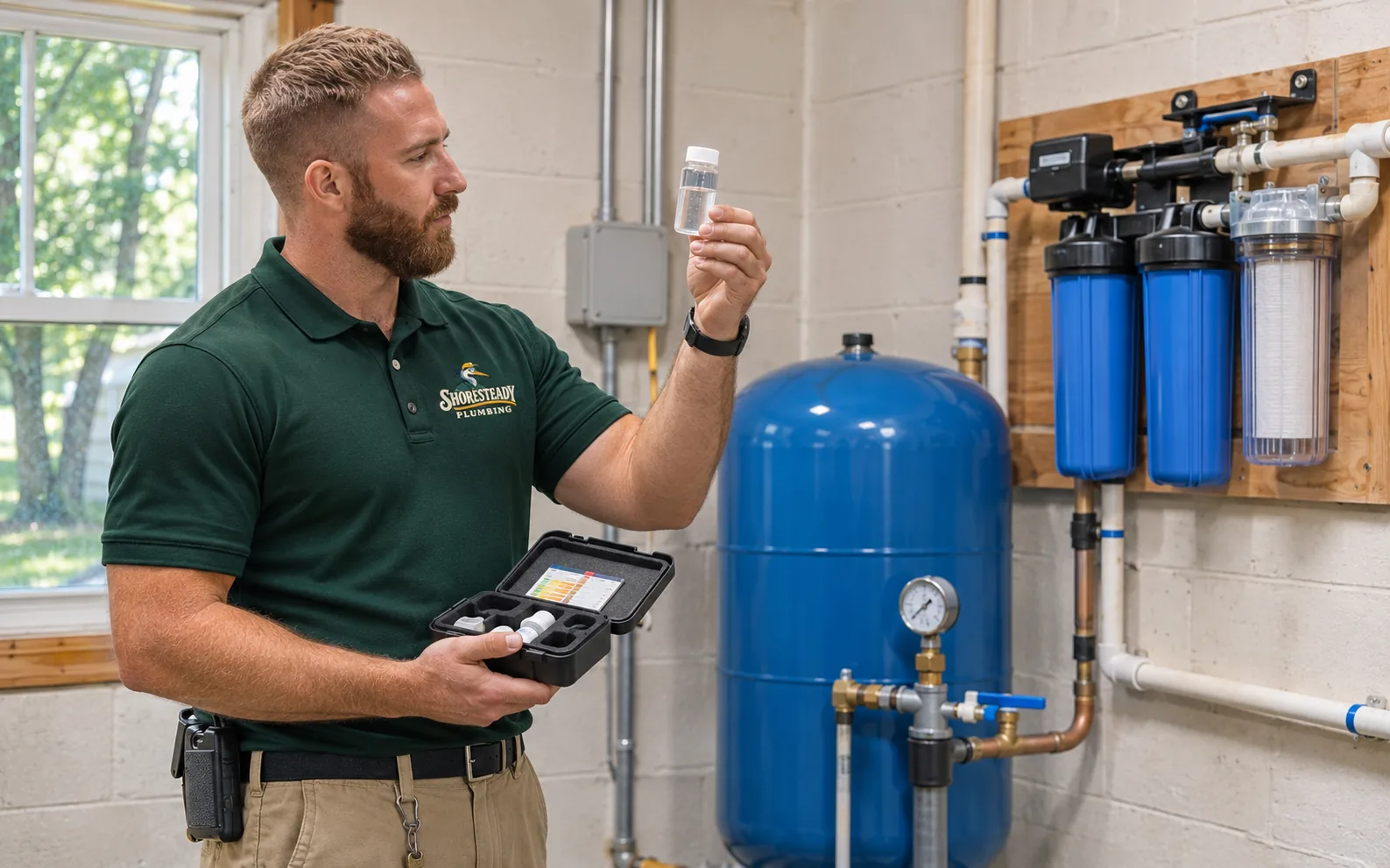
Three components, and the expensive one is the last to suspect. Here is the order to check them in before anybody sells you a new membrane.
The RO faucet that used to fill a glass in a few seconds now takes a minute, or gives you half a glass and stops. The instinct is that the membrane is finished, and membranes are the expensive part.
Check two cheaper things first, because between them they explain most of these calls.
Order of suspicion. Pre-filters, then the storage tank, then the membrane. Not the other way round.
1. The pre-filters
An RO unit has sediment and carbon cartridges ahead of the membrane. They are consumable, roughly annual, and sooner than that on well water carrying sediment or iron.
When they clog, less water reaches the membrane, so less water gets made, so the tank never fills properly and the faucet trickles. Nothing has broken. Cartridge changes sit within the $60 to $200 a year that treatment cartridges generally run.
They are also the reason a neglected RO unit eventually needs a new membrane, because protecting the membrane is their whole purpose.
2. The storage tank
This is the one almost nobody knows about, and it produces exactly the symptom people blame on the membrane.
An RO tank is not simply a container. Inside it is a bladder with an air charge on one side, working on the same principle as a well pressure tank. The membrane fills the tank slowly and the air charge is what pushes it back out fast when you open the faucet.
Lose that air and the tank fills with water but has nothing to push it out with. You get a dribble, and the tank feels oddly heavy. The unit is producing perfectly well.
Testing and recharging it is often the entire repair.
3. The membrane, last
Only after those two. A genuinely failed membrane usually shows as water that has slowly gone back to tasting like the rest of the house, rather than simply running slowly.
And if a membrane has failed inside a couple of years, replacing it is treating the symptom. That is iron, sediment or hardness reaching it untreated, which is a conversation about whole home filtration rather than about the RO unit. Fitting another membrane into the same water just restarts the clock.
Two other faults worth knowing
Water running to the drain continuously. Not normal. Usually a failed check valve or an automatic shut-off valve that is not closing, and it wastes water every hour it continues. On a septic system that is worth dealing with quickly.
Noise or dripping under the sink. Usually a fitting rather than the unit, and usually a five-minute job, but water inside a cabinet is never something to leave.
What we check, in order
Pre-filters, tank air charge, check valve, and shut-off, then membrane performance, then what is reaching the unit in the first place. That last step is the one that stops you having this conversation again in two years.
We service RO units whoever installed them. See reverse osmosis repair and maintenance, the price list, or water treatment and filtration.
Why is my reverse osmosis faucet slow?
Usually a clogged pre-filter or a storage tank that has lost its air charge. Both are routine. A failed membrane is possible but it is the last thing to suspect, not the first.
How often should RO filters be changed?
Pre-filters roughly annually, sooner on well water carrying sediment or iron. The membrane lasts several years if the water reaching it has been treated.
How do I check the RO tank?
With the tank empty, the air charge is checked at the valve on the side, the same idea as a well pressure tank. If it has lost pressure the unit makes water but cannot push it out.
Is water running to the drain constantly normal?
No. Continuous drain flow usually means a failed check valve or a shut-off valve that is not closing, and it is wasting water every hour it goes on.
My membrane failed after two years. Why?
Almost always iron, sediment, or hardness reaching it untreated. Fitting another membrane without fixing that just restarts the same clock.
Written by the team at Shoresteady Plumbing, Temperanceville, Virginia. Master plumbing licensed in Virginia and Maryland. Prices shown are typical ranges for the Eastern Shore, not a quote. Your written estimate is the only number that binds either of us.
More from the Shoresteady Plumbing blog
Home Maintenance
Your Dishwasher Is Probably Fine: Three Plumbing Faults That Look Like a Dead Machine
Water sitting in the bottom of the dishwasher usually is not the dishwasher. Three things in the cabinet next to it cause most of these...
Pipes and Leaks
How Much Does It Cost to Repipe a House on Virginia’s Eastern Shore
A whole home repipe on the Shore typically runs $6,000 to $16,000. Costs by house size, PEX against copper, what is included, and what ...
Water Heaters
How Much Does a Tankless Water Heater Cost on Virginia’s Eastern Shore
Tankless installation typically runs $4,000 to $7,500 on the Shore. Here is where the money goes, why gas line sizing drives the price,...
Reading about it is one thing, fixing it is another
Tell us what is going on and we will get you on the schedule. Written estimate before we start, and a 2-year workmanship guarantee on every job.
Explore related services
- Plumbing answers, straight from our vans
- Pressure tank repair on the Eastern Shore
- Whole home water filtration installation and replacement
- Reverse osmosis repair and maintenance on the Shore
- How Much Does a Water Treatment System Cost on Virginia’s Eastern Shore
- Water treatment and filtration installation, repair and replacement
- Your Dishwasher Is Probably Fine: Three Plumbing Faults That Look Like a Dead Machine
- How Much Does It Cost to Repipe a House on Virginia’s Eastern Shore
- How Much Does a Tankless Water Heater Cost on Virginia’s Eastern Shore
Ready for a steady hand?
Book with our team, or call us seven days a week from 8am to 9pm.
Call (757) 824-9862