
Hair you can pull out. Sand settles into the trap and the branch line and stays there, and no drain product on the shelf touches it. What a summer of beach days does to a Shore shower.
Most drain advice is written for places where the worst thing going down a shower is hair and shampoo. Out here there is a second one, it arrives every summer, and none of the usual fixes touch it.
Sand does not dissolve. It does not soften in hot water, it does not react with anything you can buy, and enzymes have nothing to eat. It is rock, in very small pieces, and the only two things that move it are physical contact and enough water pressure to carry it.
The short version. If you live near the water, the fix for a slow shower is not another bottle of drain cleaner. It is keeping the sand out, and clearing what is already in there properly.
Why sand behaves differently from hair
A hair clog forms at a restriction: the strainer, the stopper, the top of the trap. It grows across the opening like a net, so the water slows suddenly and you notice.
Sand does the opposite. It is heavier than water, so it sinks and settles anywhere the flow slows down. That means the bottom of the P-trap first, then any low spot or slight belly in the branch line. It does not block the pipe so much as slowly fill the bottom of it.
The practical effect is that a sand problem creeps up over a season or two rather than appearing overnight, and that by the time the shower is visibly slow there is a surprising amount of it spread along a length of pipe. You cannot pull that out with a hair tool, because it is not in one place.
Where it comes from, and it is not only the beach
Assateague and Chincoteague days are the obvious source, and a family coming back from a day out brings a genuine quantity of it into the house. But it is not the only way sand gets into a drain here:
- Yards. Much of the Shore sits on sandy soil. Kids playing outside bring it in on their feet every day of the summer, not just on beach days.
- Well water. On a well that is drawing sediment, the sand is arriving through the shower head rather than off your body. If you are also getting grit in faucet aerators and staining in the fixtures, the answer is water treatment and filtration rather than drain cleaning.
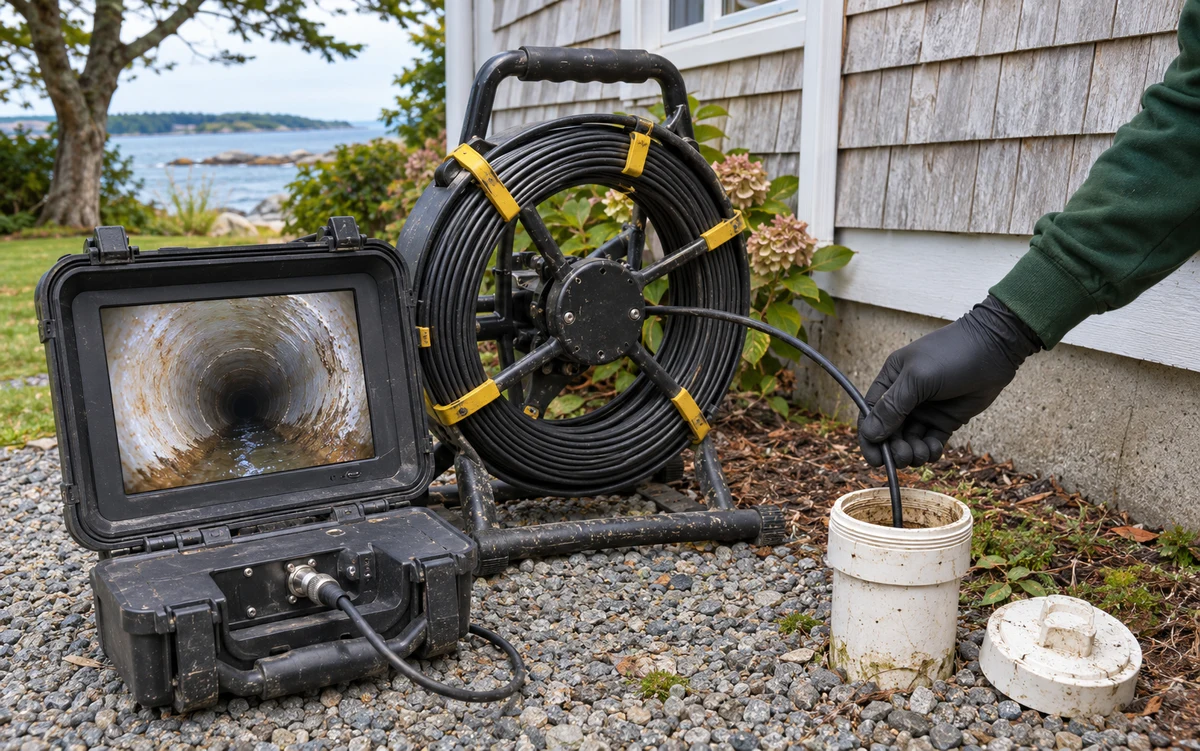
- A broken drain line. This is the serious one. A cracked or offset pipe under a sandy yard lets sand into the line from outside, and it will keep coming no matter how often the drain is cleared. If a line keeps filling with sand and nobody can explain it, that is a camera job. See sewer line repair.
Cable or jetting
This is one of the few blockages where the method genuinely matters.
A cable is a mechanical tool. It bores through a blockage and gets the water moving, which is perfect for hair and for most single fixture clogs. On sand spread along twenty feet of pipe it will get you flowing again, but a lot of the sand is still in there and you will be calling again next season.
Hydro jetting puts high pressure water down the line and carries the sand out with it rather than shifting it along. On a line that has filled with sediment it is the one that actually finishes the job. It runs $450 to $900 against $175 to $450 for a cable, and on a beach house it tends to be the cheaper choice measured over a few years.
We will tell you which one your line needs rather than defaulting to the more expensive one. If a shower has blocked once and there is hair in what comes out, it is a cable job.
Keeping it out, which is most of the battle
- Rinse off outside. The single biggest change. An outdoor shower or even a hose by the steps keeps most of it out of the house entirely. We do not fit outdoor drains, but plenty of Shore houses already have a rinse point that nobody uses.
- Shake towels and suits out before they come in. Do not rinse them in the tub, which just routes the sand straight to the drain you are trying to protect.
- Use a fine strainer, not the one that came with the shower. The standard grate is sized to stop hair. A fine mesh insert costs a few dollars and catches grit.
- Flush the drain after a beach week. Run the shower hard with nobody in it for a couple of minutes. Moving water carries fine sand along; a trickle lets it settle.
If you rent the place out
Rental properties out here take more of everything: more clogs, more wear, more of the small failures that an owner would have caught early. Guests are not going to rinse off outside unless it is obvious and pleasant, so make it obvious and pleasant. A working outdoor rinse and a mesh strainer in each shower costs less than one call out, and a line on the welcome sheet asking people to use it works better than you would expect.
If you own several units, clearing the lines between seasons rather than during them is the cheaper pattern, same as with every other fixture.
When the shower is not the problem
A shower that backs up while the toilet gurgles, or that fills when the washer drains, is not a shower clog. It is the lowest opening in the house showing you a main line problem. Stop running water and see every drain backing up.
For the ordinary version, see clogged shower drain repair, drain cleaning, or the cost guide.
Can sand really block a shower drain?
Yes, and it is one of the harder blockages to clear because nothing dissolves it. Sand settles at the bottom of the trap and in any low spot in the branch line, and each shower adds a little more.
Will a drain cleaner dissolve sand?
Nothing on a shelf will. Sand is not organic, so enzymes, acids and caustics all do nothing to it. It has to be physically removed or flushed out with enough pressure to carry it.
How do I keep sand out of the drain?
Rinse off outside before anyone gets in the shower, shake towels and swimsuits out rather than rinsing them in the tub, and use a fine mesh strainer over the drain rather than the coarse one that came with it.
How much does it cost to clear a shower drain?
A single fixture cleared with a cable runs $175 to $450. Where sand has built up along a run, hydro jetting at $450 to $900 is what actually carries it out rather than pushing it along.
Why is it worse in a rental?
More people, more beach days, and nobody rinsing off outside because it is not their house. Rental properties out here get more clogs and more wear on everything, which is worth budgeting for.
Written by the team at Shoresteady Plumbing, Temperanceville, Virginia. Master plumbing licensed in Virginia and Maryland. Prices shown are typical ranges for the Eastern Shore, not a quote. Your written estimate is the only number that binds either of us.
More from the Shoresteady Plumbing blog
Home Maintenance
Your Bathroom Sink Is Not Clogged, the Stopper Is
Most slow bathroom sinks are not blocked pipes. They are a pop-up stopper with two years of hair wrapped round the pivot rod, twelve in...
Water Heaters
How Much Does a Tankless Water Heater Cost on Virginia’s Eastern Shore
Tankless installation typically runs $4,000 to $7,500 on the Shore. Here is where the money goes, why gas line sizing drives the price,...
Drains and Sewers
How Much Does Sewer Line Repair Cost on Virginia’s Eastern Shore
Sewer work on the Shore runs from $1,500 for a spot repair to $20,000 for a full replacement. Prices, what drives them, and whether to ...
Reading about it is one thing, fixing it is another
Tell us what is going on and we will get you on the schedule. Written estimate before we start, and a 2-year workmanship guarantee on every job.
Explore related services
- Plumbing answers, straight from our vans
- Water treatment and filtration installation, repair and replacement
- Sewer line repair on the Eastern Shore
- Every drain backing up? Main line clog or septic
- Clogged shower drain repair
- Drain cleaning and clogged drains
- How Much Does Drain Cleaning Cost on Virginia’s Eastern Shore
- Your Bathroom Sink Is Not Clogged, the Stopper Is
- How Much Does a Tankless Water Heater Cost on Virginia’s Eastern Shore
- How Much Does Sewer Line Repair Cost on Virginia’s Eastern Shore
Ready for a steady hand?
Book with our team, or call us seven days a week from 8am to 9pm.
Call (757) 824-9862