
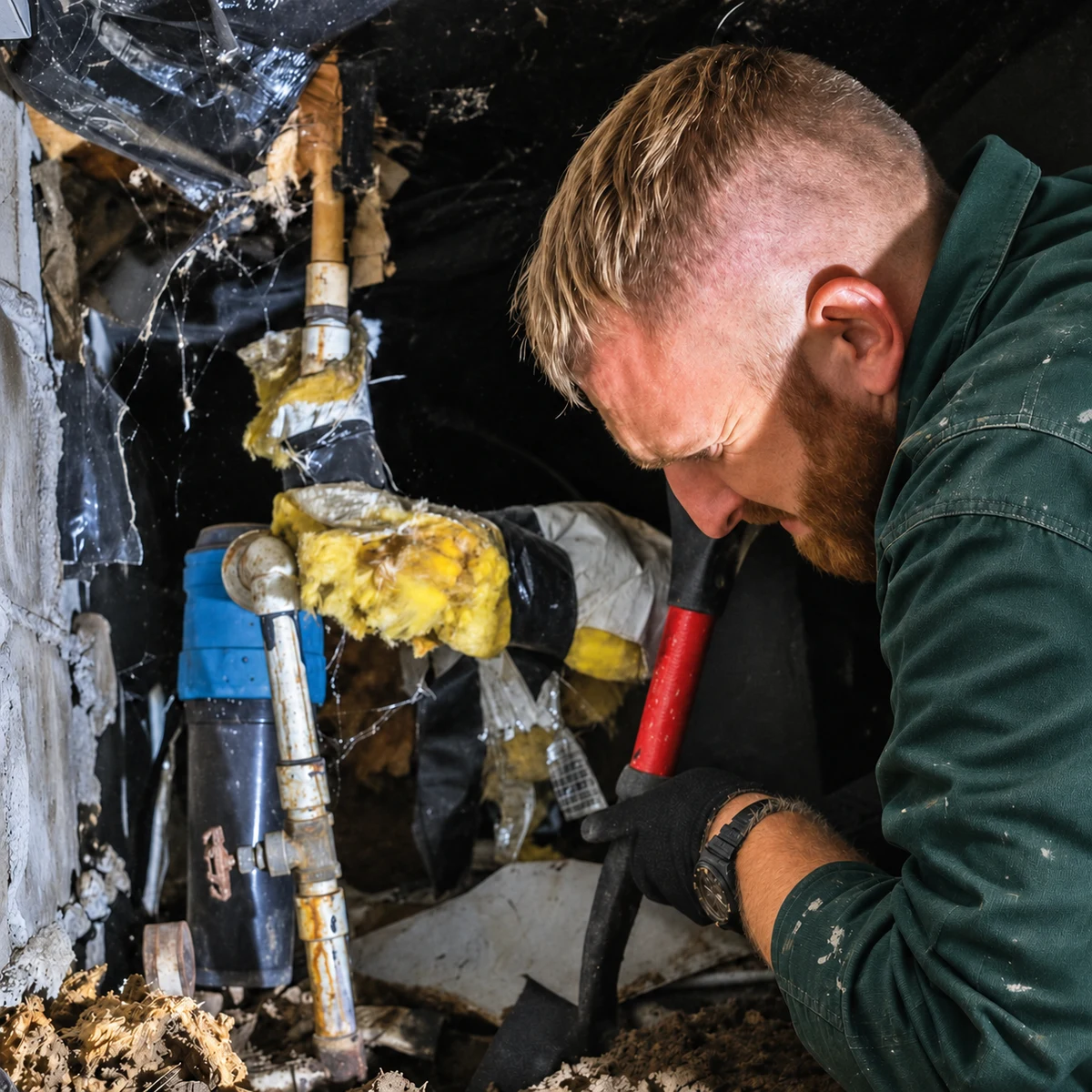
A washer empties thirty gallons in ninety seconds. On a septic tank that is not a clog problem, it is a volume problem, and the lint question has a less satisfying answer than the internet suggests.
A washing machine is the most demanding drain in the house and almost nobody thinks of it that way. A sink trickles. A shower runs steadily. A washer sits full and then empties thirty gallons in about ninety seconds, under pump pressure, into a pipe sized for a fixture that drains by gravity.
That is why the washer is usually the first thing to overflow in a house with a marginal drain, and why on septic it is the appliance that stresses the tank most.
The short version. If the standpipe overflows when the washer empties but the sinks are fine, the line is either partly blocked or it cannot breathe. Both are fixable and neither means a new machine.
The standpipe, and why it overflows
The washer drain hose hooks into a vertical pipe called a standpipe, which runs down to a trap and then into the branch line. Two things go wrong with it.
It is partly blocked. Lint, detergent residue, and the fine grit that comes out of clothes build a lining in the standpipe and the trap the same way grease does in a kitchen line. A sink draining slowly into that same line would barely notice. A washer pumping thirty gallons into it finds the restriction immediately, and the water comes back up and over the top.
It cannot breathe. A drain needs air behind the water or it will not flow, which is what the vent stack is for. If the vent is blocked, or the standpipe is too short, or the drain hose is pushed too far down and seals the pipe, the water has nowhere to push the air and it backs up. The tell for a venting problem is gurgling from another fixture when the washer drains, and a standpipe that overflows even though a cable found nothing much in the line.
Worth knowing before you call anyone: a standpipe that is too short is a real and common fault, and no amount of drain cleaning fixes it.
The lint question, answered honestly
Search this and you will find a lot of confident advice about fitting a mesh filter over the washer drain hose to protect your septic system. It is cheap, it sounds sensible, and we are not going to tell you it does nothing at all.
What we will say is that the evidence it meaningfully protects a septic system is thinner than the marketing suggests, and that it comes with a cost: a filter that nobody cleans becomes the blockage. We have pulled more than one out of a standpipe where it was the problem rather than the prevention.
If you want to reduce what leaves the machine, clean the machine’s own lint trap, do not overload it, and wash sandy beach towels on their own after shaking them out. Those do more than an add-on filter, and none of them can block your drain.
The part that actually matters on septic: volume
Most houses out here are on their own septic system. Chincoteague has no central sewer at all, and while some bayside areas are being connected to public sewer with grinder pumps, for most of Accomack and Northampton the laundry water goes into a tank in the yard.
A septic tank does its job by holding water still long enough for solids to settle to the bottom and grease to float to the top. Settling takes time. The one thing that defeats it is a large volume of water arriving quickly, because it stirs everything up and pushes the disturbed layer out toward the drain field with the outgoing flow.
Now consider Saturday laundry day: six loads back to back, each one dumping its wash and rinse water in a rush. The tank barely gets a chance to settle between them, and what leaves is dirtier than it should be. Do that every week for a few years and the drain field pays for it, which is a much bigger bill than any drain we could clear.
The fix costs nothing. Spread the laundry across the week. Two loads on three days is materially easier on a tank than six loads on one.
Water softeners, while we are on volume
If you are on well water out here, and most of the Shore is, you may have a softener or an iron filter. They regenerate on a cycle and discharge a decent slug of water when they do, often overnight when nobody notices.
Virginia’s health department guidance treats that discharge as a load on a septic system rather than as nothing, and some installations route it elsewhere with a valve instead of sending it to the tank. Whether yours should is worth asking about rather than assuming, particularly if your system has been sluggish and nobody can explain why. That conversation sits alongside water treatment and filtration rather than drain cleaning.
When the washer is telling you about the main line
This is the most useful diagnostic in the house, and it is free.
Run the washer and go stand somewhere else. If the toilet gurgles, or the tub fills, or the shower backs up while the washer is emptying, the blockage is not in the laundry line at all. The washer is simply the biggest volume of water your drainage system sees, so it is what exposes a restriction in the main.
Stop running water, do not start another load, and read every drain backing up.
Rentals and houses that sit empty
A washer in a rental does more loads, with more sand and more of everything else, and nobody cleans the lint trap. Budget for the laundry line being cleared between seasons rather than during one.
A washer in a house that sits empty has the opposite problem: the standpipe trap dries out over a few months and you get sewer smell in the laundry room when you open the place up. Run the machine on a rinse cycle, or pour a jug of water down the standpipe, and it goes away.
Getting it cleared
A laundry line cleared with a cable runs $175 to $450. If it has blocked before, or if what comes out is a grey detergent sludge rather than a single obstruction, jetting at $450 to $900 scours the pipe back rather than boring a hole through the lining. See washing machine drain repair, drain cleaning, or the cost guide.
Why does my washing machine drain overflow?
Either the standpipe is partly blocked, or it cannot breathe. A washer pump pushes water far faster than a sink does, so a line that drains a sink fine will still back up out of the standpipe when the washer empties.
Do I need a lint filter on my washing machine drain?
The evidence that an add-on filter meaningfully protects a septic system is thinner than the marketing suggests. Cleaning the machine’s own lint trap and not overloading it does more, and we would not sell you one as a fix for a blocked line.
Is it bad to do all the laundry on one day with a septic tank?
It is better to spread it out. Several loads back to back push a lot of water through the tank quickly, which stirs up settled solids and can carry them toward the drain field.
Can a water softener discharge into a septic tank?
It adds real volume, and Virginia’s health department guidance treats softener discharge as a load on the system. Some installations use a valve so the regeneration discharge goes elsewhere. Ask before assuming yours is set up the way you want.
How much does it cost to clear a washing machine drain?
A single fixture cleared with a cable runs $175 to $450. If the washer and other fixtures are backing up together, the problem is the main line at $300 to $600.
Written by the team at Shoresteady Plumbing, Temperanceville, Virginia. Master plumbing licensed in Virginia and Maryland. Prices shown are typical ranges for the Eastern Shore, not a quote. Your written estimate is the only number that binds either of us.
More from the Shoresteady Plumbing blog
Water Heaters
How Much Does a Tankless Water Heater Cost on Virginia’s Eastern Shore
Tankless installation typically runs $4,000 to $7,500 on the Shore. Here is where the money goes, why gas line sizing drives the price,...
Home Maintenance
Repair or Replace a Toilet: How to Decide
A running toilet is a $20 part. A rocking one can be a subfloor. Here is how to tell which problem you have before you spend anything. ...
Home Maintenance
Your Bathroom Sink Is Not Clogged, the Stopper Is
Most slow bathroom sinks are not blocked pipes. They are a pop-up stopper with two years of hair wrapped round the pivot rod, twelve in...
Reading about it is one thing, fixing it is another
Tell us what is going on and we will get you on the schedule. Written estimate before we start, and a 2-year workmanship guarantee on every job.
Explore related services
- Plumbing answers, straight from our vans
- Water treatment and filtration installation, repair and replacement
- Every drain backing up? Main line clog or septic
- Washing machine drain backing up
- Drain cleaning and clogged drains
- How Much Does Drain Cleaning Cost on Virginia’s Eastern Shore
- How Much Does a Tankless Water Heater Cost on Virginia’s Eastern Shore
- Repair or Replace a Toilet: How to Decide
- Your Bathroom Sink Is Not Clogged, the Stopper Is
Ready for a steady hand?
Book with our team, or call us seven days a week from 8am to 9pm.
Call (757) 824-9862