
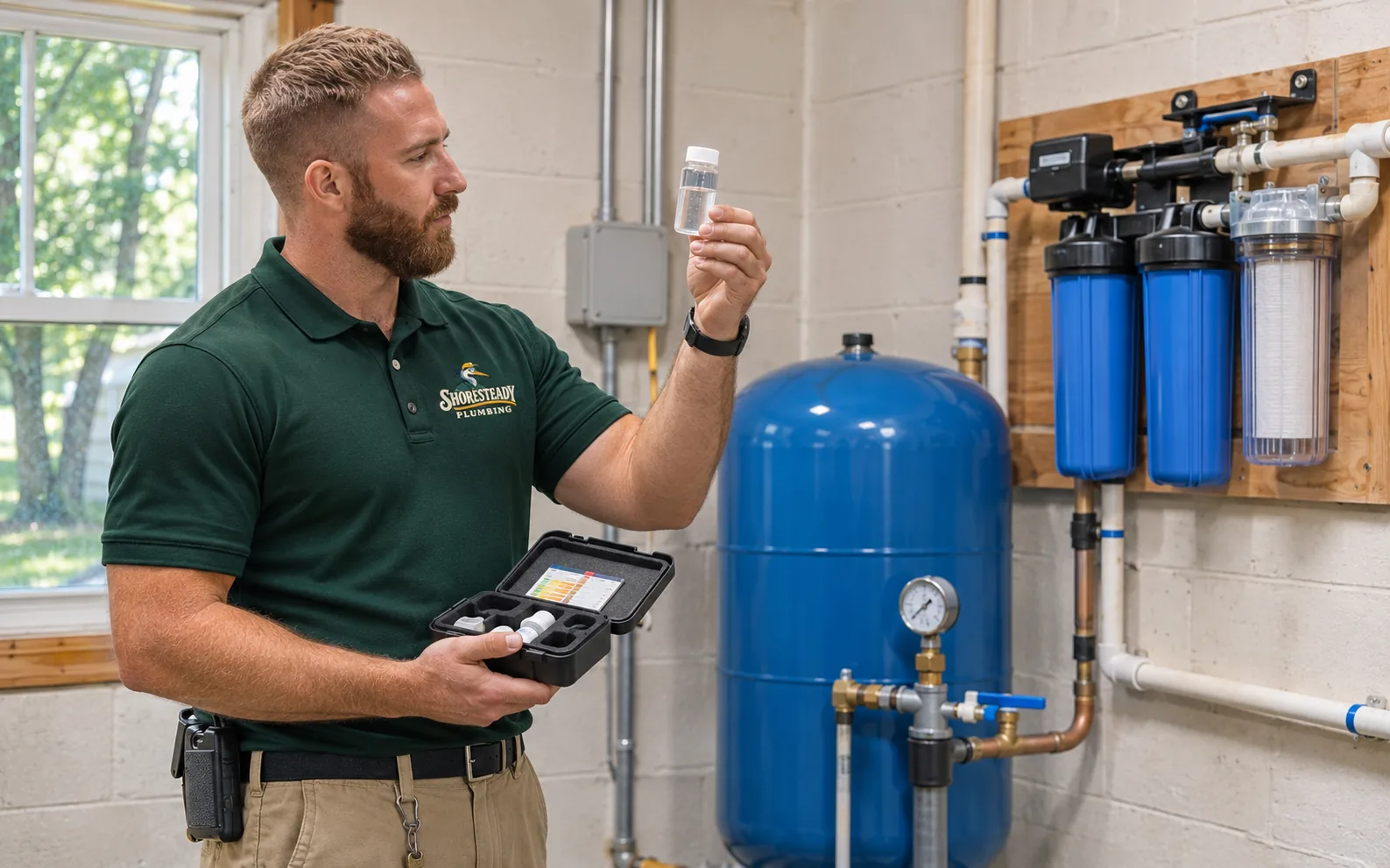
Salt bridge, blocked injector, or finished resin. Only the last one means a new unit, and it is the least likely of the three.
A softener that has stopped softening rarely announces itself. The spotty glasses come back, soap stops lathering properly, and the unit in the utility room looks exactly as it always did, humming away, brine tank full of salt.
That last detail is the trap. A brine tank full of salt does not mean the softener is using any of it.
Three causes, in order of likelihood. A salt bridge, a blocked injector or valve head, and finished resin. Only the third one means a new unit, and it is the least common of the three.
1. The salt bridge
Humidity makes salt cake. Over time it can form a solid crust that arches across the brine tank and supports itself on the walls, with an empty gap underneath.
From the top, the tank looks full. Underneath, the water never reaches the salt, so no brine is made, so every regeneration cycle runs on plain water and achieves nothing. The softener behaves perfectly and softens nothing.
The tell: the salt level has not dropped in months. If you have been topping it up and it never seems to go down, that is not a well-behaved softener, that is a bridge.
Carefully breaking the crust up can be the entire repair, and it is the first thing we check.
2. Injectors, valve heads, and drain lines
The valve head is the brain: it decides when to regenerate, draws brine through a small injector, and sends waste to the drain.
Three failures here, all of which look like nothing from outside:
- A blocked injector. It is a small orifice and it clogs with sediment or salt fines. Blocked, the unit cannot draw brine, so it cycles without recharging.
- A failed valve head or timer. Regenerating constantly, never regenerating, or sending softened water to the drain.
- A restricted drain line. The cycle cannot complete, and a brine tank full of standing water is the usual symptom.
None of these mean the softener is finished. All of them are repairs.
3. Resin that is genuinely finished
Resin beads are what actually do the softening, and they have a working life. On clean water that is a long one, comfortably a decade or more.
On Shore well water it can be much shorter, for one reason: iron. Iron coats the beads and they stop exchanging. Once a bed is fouled that way it does not recover, whatever is done to it.
At that point a replacement at $1,800 to $3,500 is the honest answer. But the important part is the next sentence: if the resin was killed by iron, fitting a new softener into the same water just starts the same clock. The fix is an iron filter ahead of it at $2,200 to $4,500, covered in whole home filtration and in sizing a softener on iron-heavy water.
One symptom that is not the softener
If what came back is orange staining rather than white scale and spotty glasses, the softener was never the thing doing that job. That is iron, and it belongs to the filter. See whole home water filtration repair.
Getting that distinction right is most of the value of the visit, because the two problems look similar from the kitchen and cost very different amounts to fix.
What we check, and what we will not do
Salt level and bridging, injector, valve head, and timer, drain line, then resin performance. In that order, so the cheap answers get found first.
What we will not do is quote a replacement before checking the other three, which on a unit that only needs its injector cleared would be an expensive way to solve nothing.
See water softener repair, the price list, or water treatment and filtration.
Why has my water softener stopped softening?
Most often a salt bridge stopping it drawing brine, a blocked injector, or a valve head no longer cycling properly. Resin failure is real but it is the last thing to suspect.
What is a salt bridge?
A crust of salt that arches over the brine tank with a gap underneath. The tank looks full, but the water below cannot reach the salt, so no brine is made and nothing regenerates.
Why is my brine tank full of water?
Usually a blocked drain line, a failed injector or a valve head fault. The unit is going through the motions of a regeneration without actually drawing brine.
How do I know if the resin is finished?
When the salt is being used, the unit is regenerating properly, the injector is clear, and the water is still hard. On iron-heavy water a fouled bed will not recover.
Is it worth repairing an old softener?
If the resin is sound, yes, easily. A valve head or injector repair is a fraction of a $1,800 to $3,500 replacement.
Written by the team at Shoresteady Plumbing, Temperanceville, Virginia. Master plumbing licensed in Virginia and Maryland. Prices shown are typical ranges for the Eastern Shore, not a quote. Your written estimate is the only number that binds either of us.
More from the Shoresteady Plumbing blog
Costs and Pricing
How Much Does Commercial Plumbing Cost on Virginia’s Eastern Shore
Commercial plumbing on the Shore runs $125 to $225 per hour plus materials, with fixed prices on scoped work. Backflow testing, grease ...
Home Maintenance
Replacing a Kitchen Sink: What Else Has to Come Out
The sink is the cheap part of a sink replacement. Here is everything else that comes out with it, and which of it is worth replacing wh...
Pipes and Leaks
How to Find a Hidden Water Leak When You Are on Well Water
On a private well there is no water bill to warn you about a hidden leak. Here is the pump test that finds one, and the three things it...
Reading about it is one thing, fixing it is another
Tell us what is going on and we will get you on the schedule. Written estimate before we start, and a 2-year workmanship guarantee on every job.
Explore related services
- Plumbing answers, straight from our vans
- Whole home water filtration installation and replacement
- Sizing a Water Softener When Your Well Has Iron in It
- Whole home water filtration repair and maintenance
- Water softener repair and maintenance on the Shore
- How Much Does a Water Treatment System Cost on Virginia’s Eastern Shore
- Water treatment and filtration installation, repair and replacement
- How Much Does Commercial Plumbing Cost on Virginia’s Eastern Shore
- Replacing a Kitchen Sink: What Else Has to Come Out
- How to Find a Hidden Water Leak When You Are on Well Water
Ready for a steady hand?
Book with our team, or call us seven days a week from 8am to 9pm.
Call (757) 824-9862