
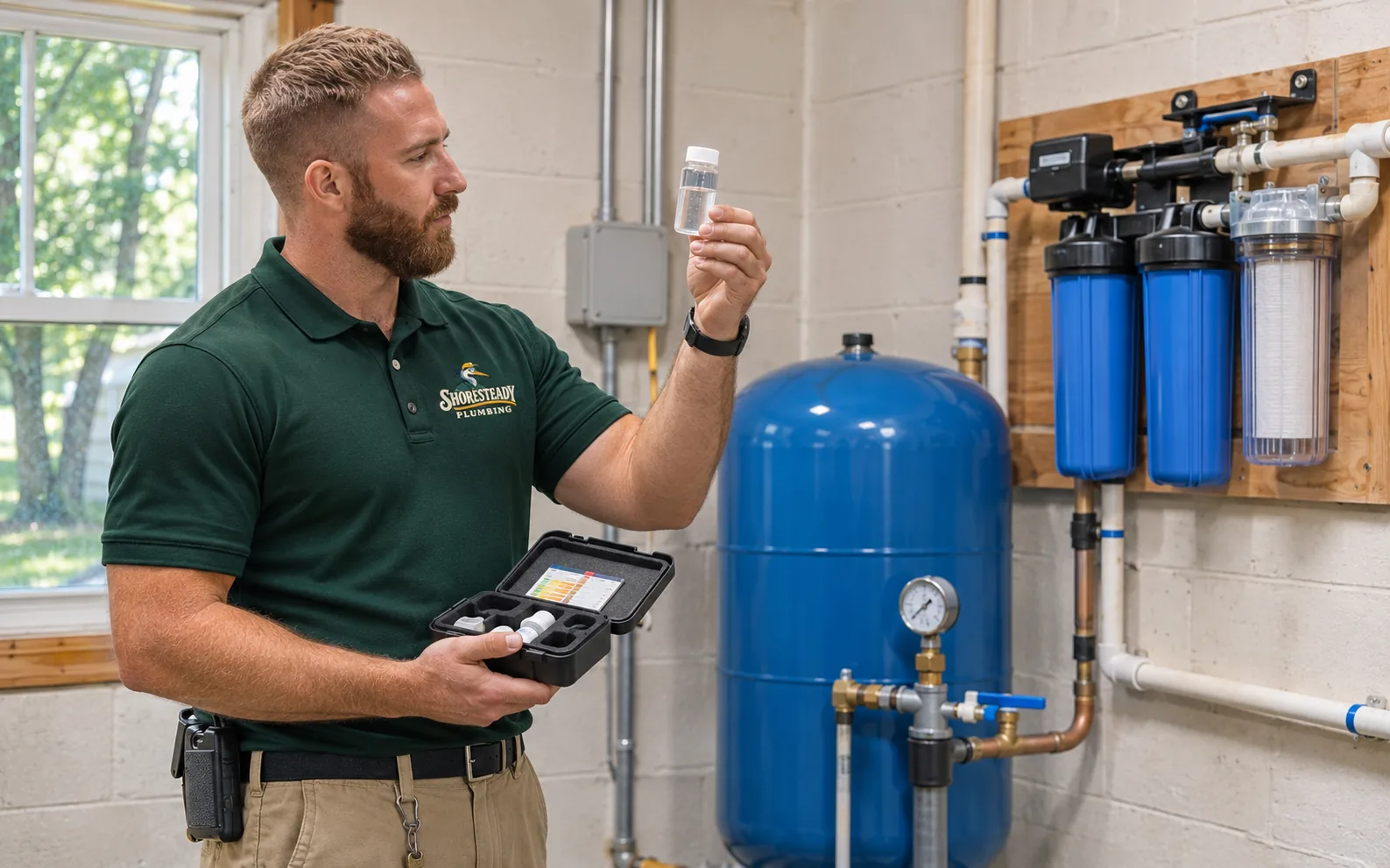
A rotten egg smell comes from one of three places, and a thirty second tap test tells you which. Here is how to find out before you spend money on the wrong equipment.
That rotten egg smell is hydrogen sulfide, and on Virginia’s Eastern Shore it is one of the most common things we get called about. The gas itself is usually harmless at well water concentrations. Where it comes from decides what fixes it, and there are only three places it can be coming from.
Do this first. Run the cold tap. Then run the hot. If only the hot side smells, it is your water heater. If both smell, it is the well. If it only smells at one fixture, it is the drain. That single test saves most people from buying the wrong equipment.
1. Only the hot water smells
This is the magnesium anode rod in your water heater reacting with sulfate reducing bacteria in the tank. It is the easiest version of the problem to fix.
The usual answer is to swap the magnesium anode for an aluminium or a powered anode, then sanitise the tank. That runs roughly $200 to $500 and it normally resolves it for good. Pulling the anode entirely is not the answer, because the tank then rusts from the inside and you buy a new heater years early.
2. Both hot and cold smell
Now it is the well or the aquifer, and it needs treatment rather than a repair. Which treatment depends on the concentration, which is why we test rather than guess.
Iron very often comes along with sulfur out here, and the same oxidising filter usually handles both. Full pricing is in what a water treatment system costs.
3. It only smells near one sink
Then it is not your water at all. It is a dry trap letting sewer gas up, or bacteria in the drain and overflow. Pour a couple of litres of water down any fixture you rarely use, wait a day, and see if it stops. Guest bathrooms in seasonal properties do this constantly.
Is it dangerous
At the levels found in well water it is a nuisance rather than a health risk. It is worth knowing that hydrogen sulfide corrodes copper, brass, and steel over time, so if you can smell it your plumbing is being worked on quietly. It also tarnishes silverware and can turn coffee bitter.
The one thing worth ruling out is bacterial contamination. A sulfur smell that appears suddenly, especially after flooding, is a reason to test for coliform bacteria rather than assume it is just sulfur.
What does not work
- A carbon pitcher filter. It will not touch a whole house sulfur problem.
- Shock chlorinating the well and nothing else. It helps for a few weeks and then the smell comes back.
- A water softener on its own. Softeners handle hardness, not sulfur.
- Pulling the anode rod out of the heater. It stops the smell and destroys the tank.
Questions We Get Asked About Sulfur Smell
Why does it smell worse in summer
Warmer water holds less dissolved gas, so more of it releases at the tap. Bacterial activity also rises with temperature. The concentration has probably not changed, only what you notice.
Will shocking the well fix it permanently
Rarely. It is a useful diagnostic and a short term improvement, but if the sulfur is in the aquifer it comes back. Treatment is the permanent answer.
Can I keep my softener and add sulfur treatment
Yes, and the order matters. Sulfur and iron removal goes first, softener second, or you foul the softener resin.
How much does the anode swap cost
Roughly $200 to $500 including sanitising the tank, and it is the right first step whenever only the hot side smells.
Do you test water
Yes, and we test before quoting equipment rather than after. See water treatment and filtration.
Find out which of the three you have
Request service and we will run the test, tell you where the smell is coming from, and quote only what actually fixes it.
Written by the team at Shoresteady Plumbing, Temperanceville, Virginia. Master plumbing licensed in Virginia and Maryland. Prices shown are typical ranges for the Eastern Shore, not a quote. Your written estimate is the only number that binds either of us.
More from the Shoresteady Plumbing blog
Well and Water Quality
Sizing a Water Softener When Your Well Has Iron in It
Hardness is only half the calculation on Shore well water. Iron changes the sizing, and ignoring it is why softeners here fail years be...
Drains and Sewers
How Much Does Sewer Line Repair Cost on Virginia’s Eastern Shore
Sewer work on the Shore runs from $1,500 for a spot repair to $20,000 for a full replacement. Prices, what drives them, and whether to ...
Pipes and Leaks
How Much Does It Cost to Repipe a House on Virginia’s Eastern Shore
A whole home repipe on the Shore typically runs $6,000 to $16,000. Costs by house size, PEX against copper, what is included, and what ...
Reading about it is one thing, fixing it is another
Tell us what is going on and we will get you on the schedule. Written estimate before we start, and a 2-year workmanship guarantee on every job.
Explore related services
- Plumbing answers, straight from our vans
- How Much Does a Water Treatment System Cost on Virginia’s Eastern Shore
- Water treatment and filtration installation, repair and replacement
- Sizing a Water Softener When Your Well Has Iron in It
- How Much Does Sewer Line Repair Cost on Virginia’s Eastern Shore
- How Much Does It Cost to Repipe a House on Virginia’s Eastern Shore
Ready for a steady hand?
Book with our team, or call us seven days a week from 8am to 9pm.
Call (757) 824-9862