
Most floor drain calls are not blockages. They are a trap that dried out in a house nobody was living in, and the smell that follows. Here is the difference, and why the ones that do back up matter.
There is a drain in your garage, or your laundry room, or the low corner of a utility space, and you have almost certainly never done anything to it. It has no faucet above it. Nothing runs into it on purpose. Most people notice it for the first time when the room starts to smell.
Here is the thing worth knowing: that smell is usually not a blockage. It is the opposite of a blockage, and the fix is a jug of water.
The short version. A floor drain has a U-bend under it holding water. That water is the only thing between you and the sewer gas in the pipe. If nothing runs into the drain for a few months it evaporates, and the smell walks in.
How a trap works, and how it fails by doing nothing
Every drain in your house has a trap: a U-shaped dip in the pipe that stays full of water after the fixture drains. That plug of water is a seal. Sewer gas coming back up the pipe hits it and stops.
A sink trap gets topped up every time you wash your hands. A shower trap gets topped up every morning. A floor drain gets topped up when something spills, which may be never.
Water evaporates. In a heated space in winter, or a garage in an Eastern Shore August, a floor drain trap can empty in a couple of months. Once it does, there is nothing sealing the pipe and the gas comes up into the room. It smells like a sewer because it is one.
The fix: pour a gallon of water slowly into the drain. The smell will be gone within the hour. Then put a note in your phone to do it every couple of months.
Why this is a Shore problem more than most places
There are thousands of houses out here that are lived in for a few weeks a year: summer places, family houses waiting on a decision, rentals that go quiet between seasons. Every one of them has traps quietly evaporating the whole time nobody is there.
That is why the most common version of this call is somebody opening a house up in May and finding the whole place smells. It is not a plumbing failure. It is every trap in the building being empty at once, and the floor drain is usually the worst of them because it is the one that never gets used even when people are home.
If you own a house that sits empty, the ten minute routine when you arrive is: run every faucet for a minute, flush every toilet twice, and pour water down the floor drain, the laundry standpipe and any shower that has not been used. Do the same before you close it up.
You will see advice to pour a little mineral oil in on top of the water, because oil does not evaporate. It genuinely slows it down. It is also not something plumbing code recognizes, it can gum up over time, and it will end up in your septic tank. We would rather tell you the truth: water works, and the real problem is remembering to do it.
When a floor drain is telling you something serious
Now the other half of this, and it is the half that costs money if it gets ignored.
A floor drain is usually the lowest opening in the building. That is the whole point of putting it in a floor. Which means that when the line it connects to backs up, the floor drain is where the water comes out first, because water finds the lowest exit.
So a floor drain that backs up while you are using water elsewhere is not a floor drain problem at all. Ask yourself what was running when it happened:
- The washing machine was draining. Classic. The washer is the biggest slug of water your system sees, and the floor drain is the lowest exit. That points at the branch or the main.
- Somebody showered or flushed. If wastewater from a fixture comes up out of the floor drain, you have a main line blockage and it is backing up to the lowest point. Stop using water.
- Nothing was running and it came up on its own. On a house with a septic system, that can mean the tank is full or the drain field is not accepting water. That is a call to a pumper before it is a call to us.
- It came up during heavy rain. Ground water getting into the drainage system, which is a different problem again and often a cracked line.
If any of those describe what happened, read every drain backing up and stop running water in the meantime.
What we do and do not do
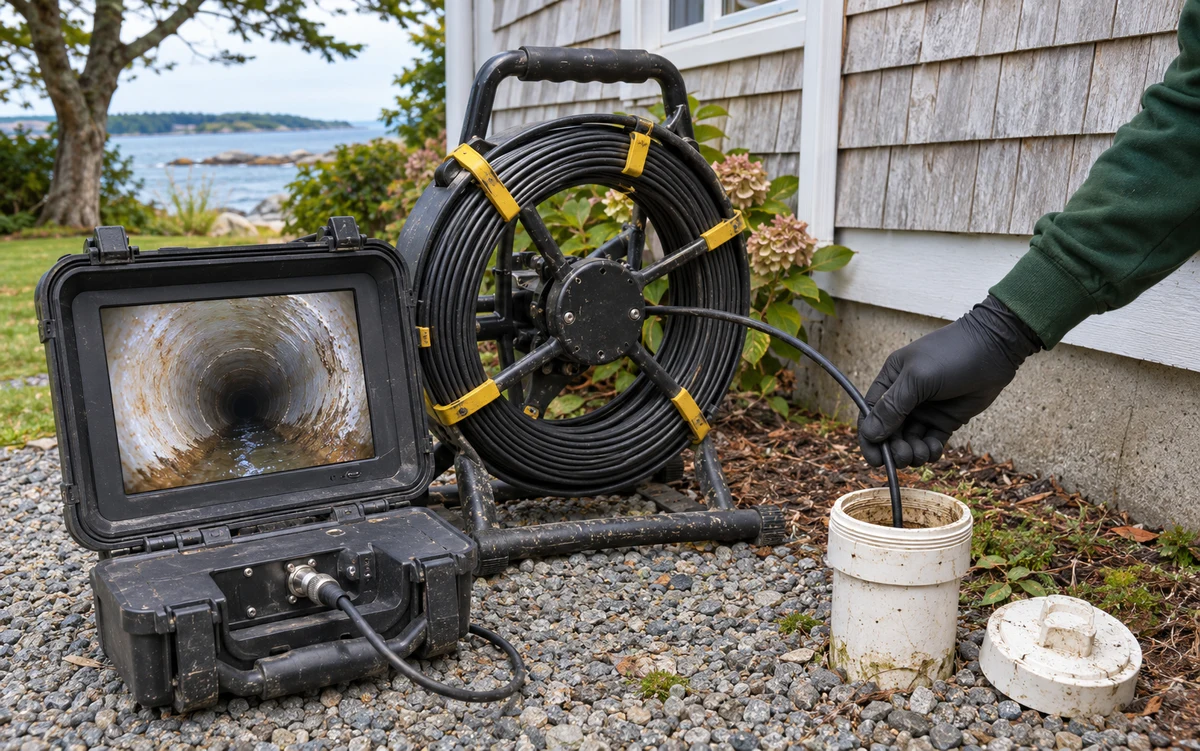
We clear floor drains, we camera the line to find out why one keeps backing up, and we jet lines that have built up over years. What we do not do is pump septic tanks: if the camera shows the line is clear and the tank is the problem, we will tell you straight and you want a pumper rather than us. Virginia expects most conventional tanks to be pumped on roughly a five year cycle, and the health department can confirm what applies to yours.
Indoor floor drains are ours. Outdoor and yard drains are not something we take on, so if the water is coming up outside the building that is a different trade.
In garages and commercial spaces
Garage floor drains collect grit, sand, and whatever washes off a vehicle, and that settles in the trap where it cannot be flushed out by evaporation or a jug of water. Those genuinely do block, and they are the one floor drain that benefits from being cleared on a schedule rather than when it fails.
The same goes for shops, kitchens and any commercial space where the floor gets hosed down. If the floor drain is part of how you clean, it is part of what you maintain. We run recurring drain maintenance for businesses, which is covered under commercial plumbing.
If it needs clearing
A floor drain cleared with a cable runs $175 to $450, and a camera at $250 to $500 is worth it if it has backed up more than once, because a floor drain that keeps backing up is nearly always a symptom rather than a cause. See floor drain cleaning, drain cleaning, or the cost guide.
Why does my floor drain smell?
Almost always a dry trap. The U-bend under the drain holds water that blocks sewer gas, and if nothing runs into that drain for a few months the water evaporates and the gas comes up. Pour a gallon of water in and the smell goes.
How often should I pour water into a floor drain?
Every couple of months in a house that is lived in, and before you leave and when you arrive in a house you only use part of the year. It takes thirty seconds and it is the whole maintenance requirement.
Is it safe to pour oil into the trap to stop it evaporating?
It is a common trick and it does slow evaporation, but it is not something plumbing code recognizes and it can cause its own problems. Water and a reminder on the calendar is the answer we would give.
My floor drain backed up. Is that serious?
It can be. A floor drain is usually the lowest opening in the building, so when a main line blocks that is where it shows first. If it backed up while you were using water elsewhere, treat it as a main line problem rather than a floor drain problem.
How much does it cost to clear a floor drain?
A single fixture cleared with a cable runs $175 to $450. If it is the main line showing up at the lowest point, that is $300 to $600 through the cleanout.
Written by the team at Shoresteady Plumbing, Temperanceville, Virginia. Master plumbing licensed in Virginia and Maryland. Prices shown are typical ranges for the Eastern Shore, not a quote. Your written estimate is the only number that binds either of us.
More from the Shoresteady Plumbing blog
Drains and Sewers
What Actually Goes Down Shore Toilets, and Why Wipes Do Not Come Back Out
Wipes sold as flushable do not break apart like toilet paper. On a septic system that is not just a clog, it is a tank problem. Here is...
Well and Water Quality
Why Faucets Fail Early on Well Water
If you are replacing faucets every few years, the faucet is probably not the problem. Here is what well water does to them and what las...
Water Heaters
Six Signs Your Water Heater Is About to Fail
Water heaters usually warn you for six to twelve months first. Rumbling, rusty hot water, puddles, short showers, swinging temperature ...
Reading about it is one thing, fixing it is another
Tell us what is going on and we will get you on the schedule. Written estimate before we start, and a 2-year workmanship guarantee on every job.
Explore related services
- Plumbing answers, straight from our vans
- Every drain backing up? Main line clog or septic
- Commercial plumbing on the Eastern Shore
- Clogged floor drain cleaning
- Drain cleaning and clogged drains
- How Much Does Drain Cleaning Cost on Virginia’s Eastern Shore
- What Actually Goes Down Shore Toilets, and Why Wipes Do Not Come Back Out
- Why Faucets Fail Early on Well Water
- Six Signs Your Water Heater Is About to Fail
Ready for a steady hand?
Book with our team, or call us seven days a week from 8am to 9pm.
Call (757) 824-9862