
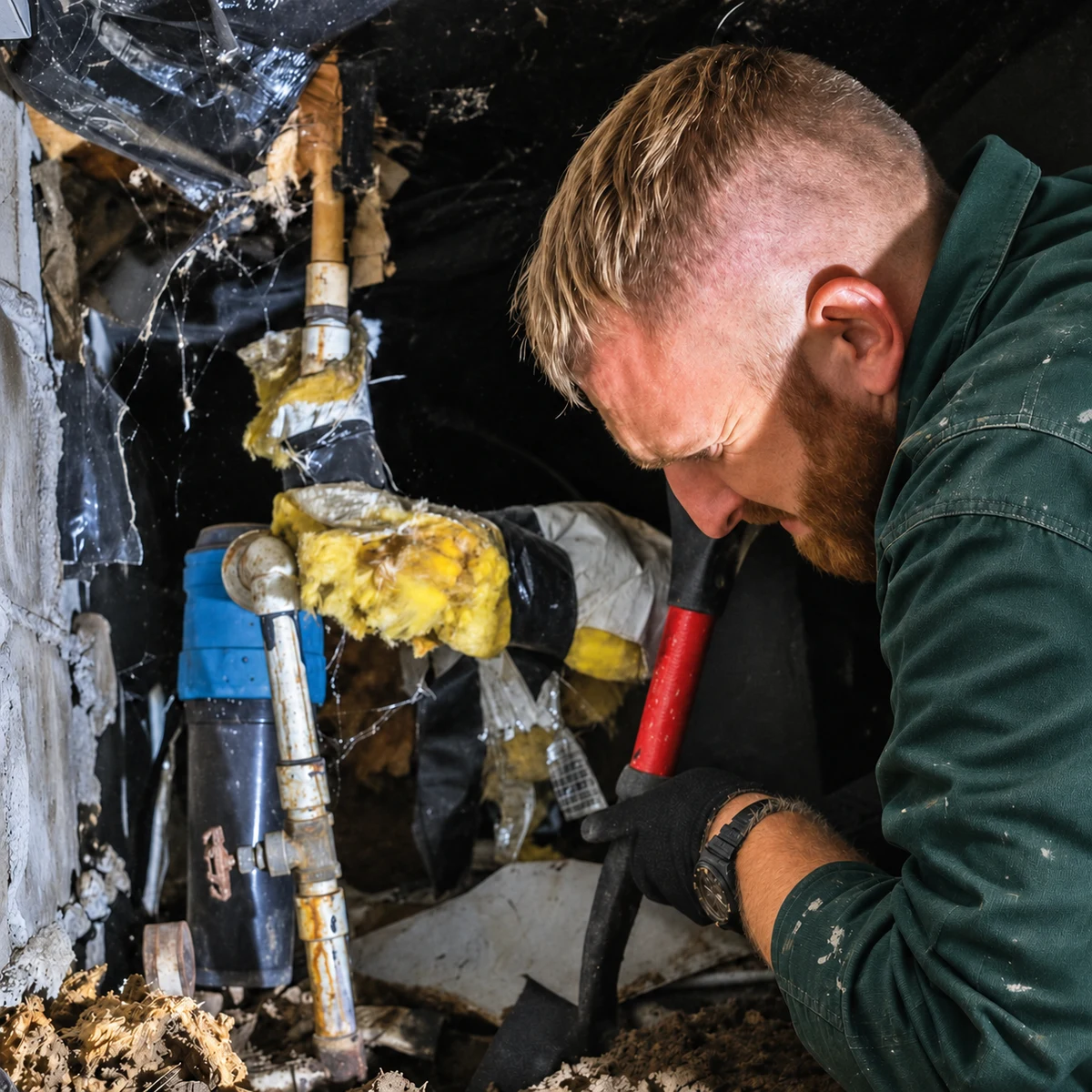
Both look identical from inside the house and they need two different companies. Here is how to work out which one you have before anybody drives out.
The toilet will not flush. The tub is filling with water nobody ran. Something is gurgling. This is the call we get more than any other, and from inside the house there are only two real possibilities.
Either the pipe between your house and wherever the waste goes is blocked, or the place it goes is full. They look identical from your bathroom floor. They need two different companies.
Right now, before anything else. Stop using water. All of it: no flushing, no showers, no dishwasher, and stop the washing machine mid cycle if it is running. Everything you send down has nowhere to go and it will come up at the lowest opening in the house.
First, confirm it really is the main
One slow fixture is a fixture problem. What you are looking for is more than one, and specifically the pattern:
- More than one fixture backing up at the same time.
- The lowest fixtures going first: a ground floor tub, a shower, a floor drain.
- A toilet that gurgles when the washing machine drains, or a tub that fills when a toilet is flushed.
- Water appearing in a fixture nobody was using.
That is everything downstream of the point where your fixtures join, which means the main line, the tank, or the drain field.
The test that splits it: look in the tank
If you are on septic, and most of the Shore is, this is the check that tells you who to call. Only do it if you can do it safely: septic gas is genuinely dangerous, never lean into an open tank, and never go in one.
Find the inspection port or the access lid. Most tanks have two, one over the inlet and one over the outlet. Lift the one on the inlet side and look at the water level.
If the level is at or above the outlet pipe, the tank is full and not draining away. Your blockage is downstream of the tank: a full tank that has not been pumped, or a drain field that has stopped accepting water. You need a pumper, and possibly a septic contractor, not a plumber. We will tell you the same thing if you call us, so you may as well save the visit.
If the level is normal, below the outlet, the tank is fine and the waste is not reaching it. The blockage is in the line between your house and the tank, and that is squarely ours.
If you are on public sewer, which applies in parts of the Shore and increasingly in some bayside areas that are being connected with grinder pumps, then there is no tank and the same logic points at the lateral to the main.
If you cannot get to the tank
Plenty of people do not know where their tank is, and that is normal. Two other tells:
Has it been pumped in the last five years? Virginia expects most conventional tanks to be pumped on roughly a five year cycle, and the health department can tell you what applies to your system. If nobody can remember the last time, that alone makes a full tank the leading suspect.
Is the ground over the drain field soggy, or unusually green? A drain field that has stopped accepting water shows on the surface. That is not a clog and clearing the line will not fix it.
If neither applies and the house has a history of roots or repeat blockages, the line is more likely.
What causes the line itself to block
When it is the line, it is usually one of four things, and the camera tells us which within a few minutes:
- Roots. They find the joints in clay and cast iron, particularly on older runs out toward the road, and they rebuild every spring. Cutting them out runs $350 to $800 and buys you time; the camera tells you whether the joint underneath is still sound.
- Wipes and what came with them. The single most common man-made cause. They do not break down, they catch on anything rough, and they knit together with floss and grease into something solid. See why flushable wipes are not flushable.
- Grease. Years of kitchen waste narrowing the pipe until something ordinary catches. See where kitchen grease actually goes.
- The pipe itself. A belly holding water, a crushed section, an offset joint, or a collapsed run. This is why a line that blocks twice in a year is not a cabling problem. It is a sewer line problem, and the answer may be a spot repair at $1,500 to $4,500 rather than another clearing.
What we actually do when we get there
We find or fit a cleanout, cable the line through it to get you flowing, and then, if it has happened before, put a camera down to find out why. Cabling the main runs $300 to $600 and a camera inspection is $250 to $500. Where the line has built up over years rather than blocked at one point, jetting at $450 to $900 scours it back to full diameter instead of boring a hole through the middle.
If your house has no accessible cleanout, fitting one is $400 to $1,200 and it makes every future visit cheaper and less invasive. On an older Shore house with a history of blockages it usually pays for itself on the second call.
While you wait
- Nobody uses water. This is the whole of the emergency advice and it is the part people find hardest.
- Do not pour chemicals into a backed up line. They sit in standing water doing nothing and make the job dangerous for whoever opens it.
- If sewage has come up onto a floor, keep people and pets off it and photograph it before you clean, in case you end up making a claim.
- If it is late, shut the water off at the main and the damage stops until morning. We take urgent calls seven days a week, 8:00am to 9:00pm, at the same price as any other visit. See emergency plumbing.
Getting it sorted
See every drain backing up for what the visit involves, drain cleaning for the methods, or the cost guide for the numbers. And if the tank is the problem, call a pumper first. We would rather tell you that than take the trip.
How do I know if it is the main line or the septic tank?
Look in the tank’s inspection port if you can get to it safely. If the level is above the outlet pipe, the tank or the drain field is the problem and you need a pumper. If the level is normal and the house is still backing up, the blockage is in the line between the house and the tank, and that is a plumber.
Do you pump septic tanks?
No. We clear and camera the line between the house and the tank, and we repair or replace that line. Pumping is a separate trade and we will tell you plainly when that is what you need rather than selling you a drain cleaning that will not help.
Why is everything backing up at once?
Because every fixture in the house drains into one pipe. When that pipe is blocked, the water comes out of the lowest opening it can find, which is usually a tub, a shower or a floor drain on the ground floor.
What should I do right now?
Stop using water everywhere in the house, including the washing machine and the dishwasher. Do not flush. Every gallon you add has nowhere to go and comes up somewhere you do not want it.
How much does it cost to clear a main line?
Cabling the main through a cleanout runs $300 to $600. A camera inspection is $250 to $500 and is worth it if the line has blocked before, because repeat blockages usually have a physical cause.
Written by the team at Shoresteady Plumbing, Temperanceville, Virginia. Master plumbing licensed in Virginia and Maryland. Prices shown are typical ranges for the Eastern Shore, not a quote. Your written estimate is the only number that binds either of us.
More from the Shoresteady Plumbing blog
Drains and Sewers
Where Kitchen Grease Actually Goes on a Septic System
Hot water and dish soap do not make grease disappear. They move it twenty feet down the line to where it cools. Here is what that does ...
Home Maintenance
Walk-In Shower or Keep the Tub: What the Plumbing Side Involves
Before you decide between a walk-in shower and a tub, it helps to know which parts of the job are plumbing, which are not, and where th...
Drains and Sewers
The Floor Drain Nobody Thinks About Until It Smells
Most floor drain calls are not blockages. They are a trap that dried out in a house nobody was living in, and the smell that follows. H...
Reading about it is one thing, fixing it is another
Tell us what is going on and we will get you on the schedule. Written estimate before we start, and a 2-year workmanship guarantee on every job.
Explore related services
- Plumbing answers, straight from our vans
- What Actually Goes Down Shore Toilets, and Why Wipes Do Not Come Back Out
- Where Kitchen Grease Actually Goes on a Septic System
- Sewer line installation, repair, and replacement
- Sewer line repair on the Eastern Shore
- Emergency plumbing on the Eastern Shore
- Every drain backing up? Main line clog or septic
- Drain cleaning and clogged drains
- How Much Does Drain Cleaning Cost on Virginia’s Eastern Shore
- Walk-In Shower or Keep the Tub: What the Plumbing Side Involves
- The Floor Drain Nobody Thinks About Until It Smells
Ready for a steady hand?
Book with our team, or call us seven days a week from 8am to 9pm.
Call (757) 824-9862