
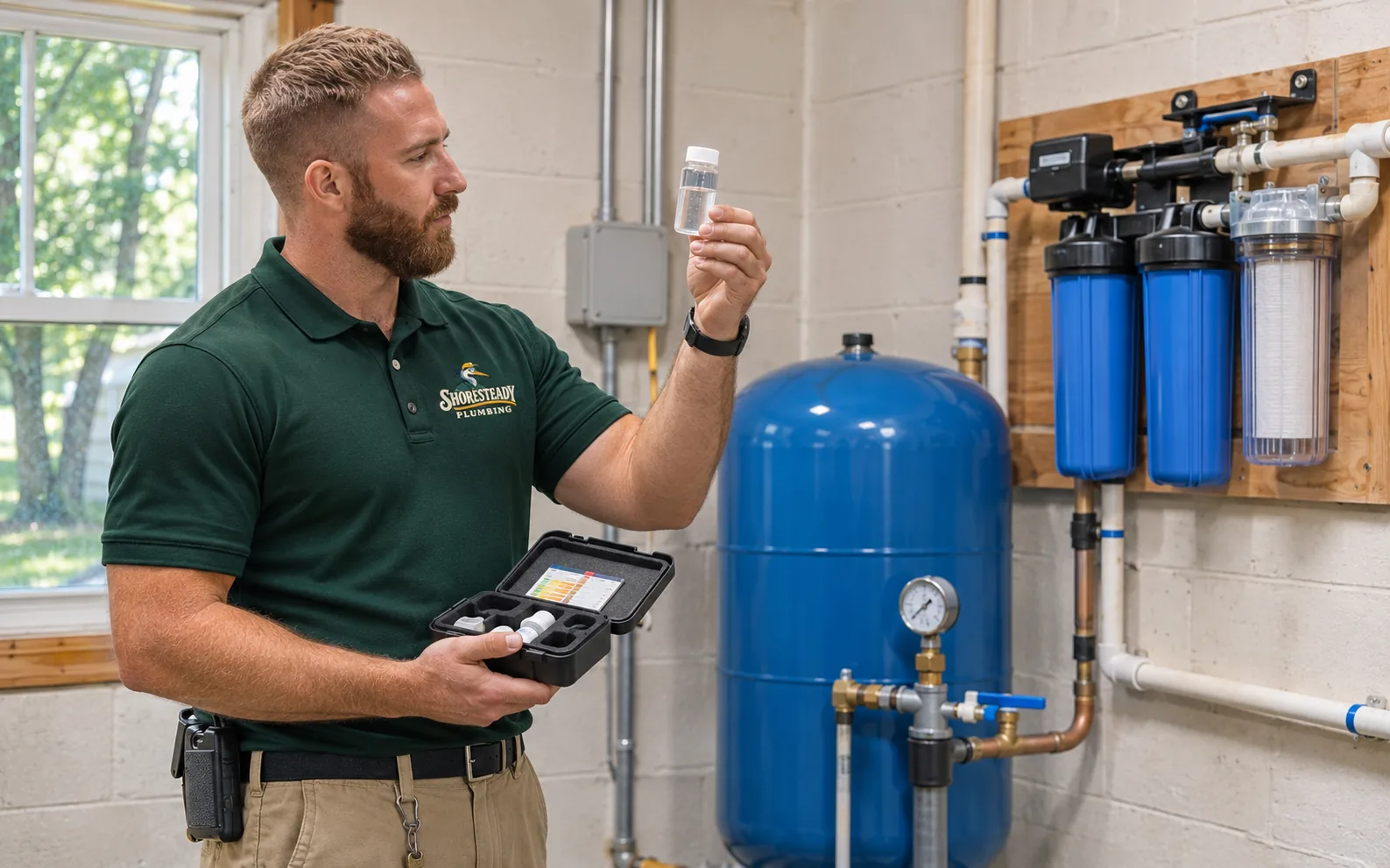
Sediment, iron, softener, UV, reverse osmosis. That sequence is not a preference, and putting the softener in the wrong place is how people destroy a $1,800 to $3,500 unit in two years.
Water treatment is usually sold as a box. You have a problem, here is the unit that fixes it, we will put it where there is room.
On Shore well water that is how expensive equipment dies young, because these units are not independent. Each one is protecting the one behind it, and the order they sit in decides how long they last.
The sequence. Sediment, then iron and sulfur, then the softener, then UV, then reverse osmosis at the sink. Each stage hands cleaner water to the next.
1. Sediment, first, and always
Grit and fine sand are abrasive, and everything downstream has moving parts or delicate media. A sediment filter at $900 to $2,500 as part of a carbon and sediment setup is the cheapest insurance in the chain.
It is also the stage people notice when it is neglected, because a clogged sediment cartridge drops pressure through the entire house and gets blamed on the well pump.
2. Iron and sulfur, before the softener
This is the one that matters most here, and the one most often got wrong.
An iron and sulfur filter runs $2,200 to $4,500 and it is what most well owners on the Shore actually need. It is what stops the orange staining and the rotten-egg smell. Where the smell comes from decides the fix, and there is more on that in why well water smells like sulfur.
Now the important part. A water softener will remove a little iron. Then it fouls. Iron coats the resin beads, they stop exchanging, and no amount of salt brings them back.
So if the softener sits ahead of the iron filter, or there is no iron filter at all, the softener is absorbing a problem it was never designed for. Above roughly 3 parts per million of iron you need a dedicated filter ahead of it, not instead of it. That single sentence is the most useful thing on this page.
3. The softener
$1,800 to $3,500, plus roughly $60 to $150 a year in salt, and it handles hardness: the white scale, the spotty glasses, the water heaters that fail at eight years instead of twelve.
Sitting third in the chain, it receives water that has already had the grit and the iron taken out of it, which is why a properly sequenced softener lasts ten to fifteen years and a badly sequenced one does not. See water softener installation.
4. UV disinfection
$700 to $1,500, and only after a positive bacteria test. UV goes late in the chain for a practical reason: it works by shining light through the water, so anything cloudy or iron-stained ahead of it shades the organisms it is supposed to kill.
Put UV on untreated well water and it looks like it is working. The lamp glows, nothing alarms, and the disinfection is a fraction of what it should be. The lamp is an annual $120 to $220 replacement, and a lamp still glowing at eighteen months is no longer doing the job.
5. Reverse osmosis, last, and local
RO is not part of the whole-home chain at all. It goes under one sink at $450 to $1,100 and polishes drinking and cooking water.
It is also the most fragile thing in the house, and it fails fast on iron, sediment or hardness. An RO membrane dying in two years is nearly always a message about what is reaching it. See reverse osmosis installation.
What this looks like in a real Shore house
Very few houses need all five. A typical well here needs sediment and iron removal and nothing else, because iron rather than hardness is the local story. Another one street over needs a softener and no iron filter at all. That is why the test comes first.
A water test is $0 to $250 and it gives you hardness, iron, manganese, pH, and sulfur. Anybody quoting a system before testing is selling equipment rather than solving a problem.
If you already have equipment in the wrong order
It is usually fixable without buying everything again. Re-plumbing the sequence is far cheaper than replacing a fouled softener every few years, and it is worth doing before you replace anything, not after.
See whole home water filtration installation, the full price list, or water treatment and filtration for how the whole thing fits together.
What order should water treatment equipment go in?
Sediment first, then iron and sulfur removal, then the softener, then UV, with reverse osmosis last at the sink. Each stage protects the one behind it, which is the whole reason the order exists.
What happens if the softener goes before the iron filter?
The softener takes the iron hit instead of the filter. It removes a little, fouls, and the resin is ruined years early. That is a $1,800 to $3,500 unit failing because it was placed wrong.
Where does the equipment physically go?
Wherever the water enters the house and ahead of the water heater, in a crawlspace, utility room or well house, provided it will not freeze.
Do I need every stage?
No, and most houses do not. The test decides. Plenty of Shore houses need sediment and iron removal and no softener at all, because iron rather than hardness is the local problem.
Does all of this need a drain?
Backwashing filters and softeners do, plus an outlet nearby. On a septic system the discharge has to be routed so it does not overload the drain field.
Written by the team at Shoresteady Plumbing, Temperanceville, Virginia. Master plumbing licensed in Virginia and Maryland. Prices shown are typical ranges for the Eastern Shore, not a quote. Your written estimate is the only number that binds either of us.
More from the Shoresteady Plumbing blog
Drains and Sewers
How Often Should You Have Your Drains Cleaned
Most homes do not need a drain cleaning schedule at all. Here is who does, the warning signs that come first, and the difference betwee...
Drains and Sewers
What a Washing Machine Actually Does to a Septic System
A washer empties thirty gallons in ninety seconds. On a septic tank that is not a clog problem, it is a volume problem, and the lint qu...
Drains and Sewers
What Actually Goes Down Shore Toilets, and Why Wipes Do Not Come Back Out
Wipes sold as flushable do not break apart like toilet paper. On a septic system that is not just a clog, it is a tank problem. Here is...
Reading about it is one thing, fixing it is another
Tell us what is going on and we will get you on the schedule. Written estimate before we start, and a 2-year workmanship guarantee on every job.
Explore related services
- Plumbing answers, straight from our vans
- Why Your Well Water Smells Like Sulfur and What Actually Fixes It
- Water softener installation and replacement on the Shore
- Reverse osmosis installation and replacement on the Shore
- Whole home water filtration installation and replacement
- How Much Does a Water Treatment System Cost on Virginia’s Eastern Shore
- Water treatment and filtration installation, repair and replacement
- How Often Should You Have Your Drains Cleaned
- What a Washing Machine Actually Does to a Septic System
- What Actually Goes Down Shore Toilets, and Why Wipes Do Not Come Back Out
Ready for a steady hand?
Book with our team, or call us seven days a week from 8am to 9pm.
Call (757) 824-9862